” I have a long running series of paintings that I’ve been making for years now. I’ve consider them to be a form of network paintings, because the holders of them form a network. The image of each painting on this page is no longer one single form as it is shown here, because I’ve they were cut into smaller pieces, and placed inside of books. At other times I’ve placed them directly into peoples hands. When I’ve placed them within books, my intention had been that these painted fragments be discovered by others through the sense of touch, in a moment of happenstance. In this, the significance of each painting and its pieces is not their image, individually, it is their collective interconnectivity. Therefore, the more discovered, the more powerful.
While one may discover a single piece, there exists a digital image of the painting in its entirety, a photograph which they come to see, by visiting a URL address, which is listed on the back of each painting piece. The image of the uncut painting is a view of the painting as it was, is, and always will be, is not, and will never be again. Amidst this tension, the discoverer or collector is inculcated into a network of others that hold similar paintings” – Ayzay
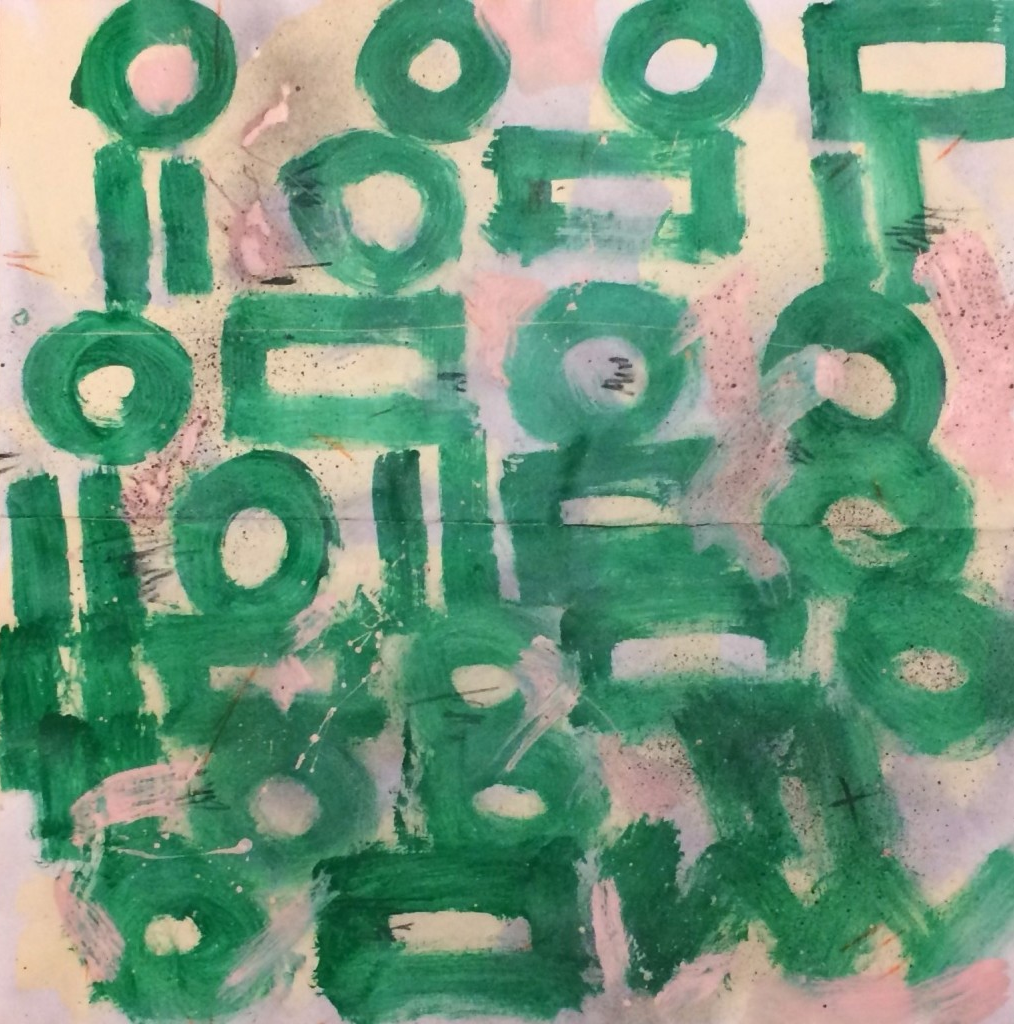
“VALENCIA” (California, US), Mixed-media on unstretched canvas, 36 x 36 in (92 x 92 cm), 2015
Notes on placing “VALENCIA“:
In a way, the painting which you see to the left is particularly special, because its pieces were placed a clinical setting of a room full of strangers, each already deeply invested with expectations and a predilection for discovery. I had placed over twenty books on a very small shelf bearing two levels and barely two feet in horizontal length. Very deliberately, I asked each in attendance to take one of the books from the assortment. They had not known there were the painting pieces, within each book. But, they would discover them in unison, before we all entered discussion on what had happened.
This was well outside of the typical encounter that I imagine one has, likely in isolation, when they discover a painting in a book. However, the unity of these multiple painting pieces were not without significance, as a visual within the hands of a collective. The exercise of that day successfully highlighted what tends to be a lesser considered aspect of these paintings– at base-level, the large painting that has been cut is a kind of network. When you look across a room and see something of familiarity in another’s hands it is clear.
By the time that I had demonstrated this practice at CalArts, I had already cut up and performed placements of every painting that follows on this page. If you would have told me, only a year before that day that I would be in the setting of a room, explaining this painting practice, I would have laughed. But, there I was in that moment, explaining the intriguing nature of stowing a painting in a book. Some decried the destruction of the painting, which is typical. A few understood the primacy of the connection, even if subtle, and a few didn’t get it. But, that’s typical of most experiences. No? Some feel it. Some don’t, and others just don’t care... until it happens to them.

“DUBAI” (UAE), Mixed-media on patchwork stitched unstretched canvas (Uncut), 2014
Notes on placing “DUBAI“:
“After cutting up a painting, I write a message on the back of each piece that I’ve cut from the larger work. It’s essentially a set of contact information, ;an explanation and a url address that someone can connect to online. I believe that the deeper the physicality, and intimacy, then the richer the experience. So, I handwrite my message on the back of each piece. I want each discoverer to know that I took my time to compose a message for them. It is uniformly, mostly, the same message on each piece. But, it is uniquely written for them, not rubber-stamped, or a QR-code. I write the message in the language spoken within the area that I am placing in. So, when I visited Dubai, I wrote a message in Arabic on the back of each painting piece. write the message to them.It was an interesting exercise, because the writing felt pictographic, as I copied a translation that was given to me.
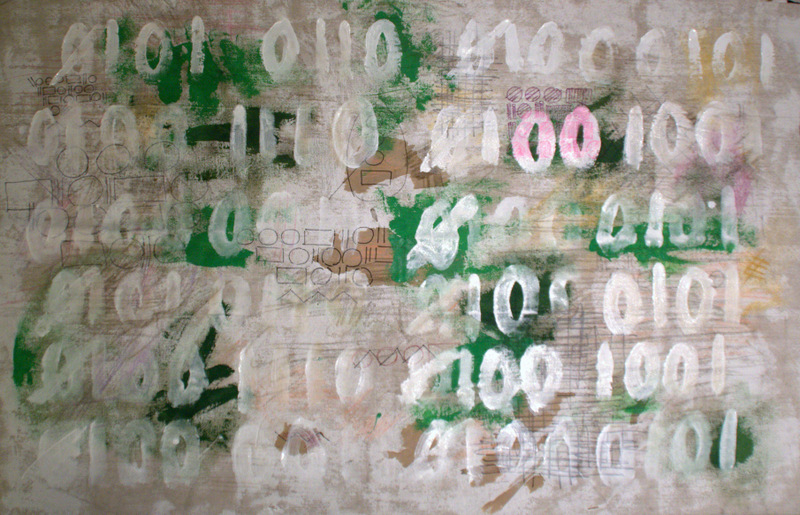
“VENICE” (ITALY), Mixed-media on unstretched canvas (Uncut), 2013
Notes on placing “VENICE“:
“Just before the 55th Venice Biennale of 2013, I visited Venice, Italy. I had taken a stay within a hotel in Rome on the day before. I completed this painting in the hotel room. After the painting dried, I cut it into two large pieces. I kept one of the large pieces for future display. The other, I cut further, into 18 pieces, that would easily fit into books. I took the train up to Venice, where I visited five used bookstores; Libri Curiosi Scontati, La Tolleta, Libreria Goldini, Libreria Acqua Alta, and Studium, Inside of these bookstores, I placed each of the painting pieces for discovery, between the pages of various books. During the 55th Venice Biennale of 2013, a few of the visitors to the event collected the tactile paintings and contacted me online.”
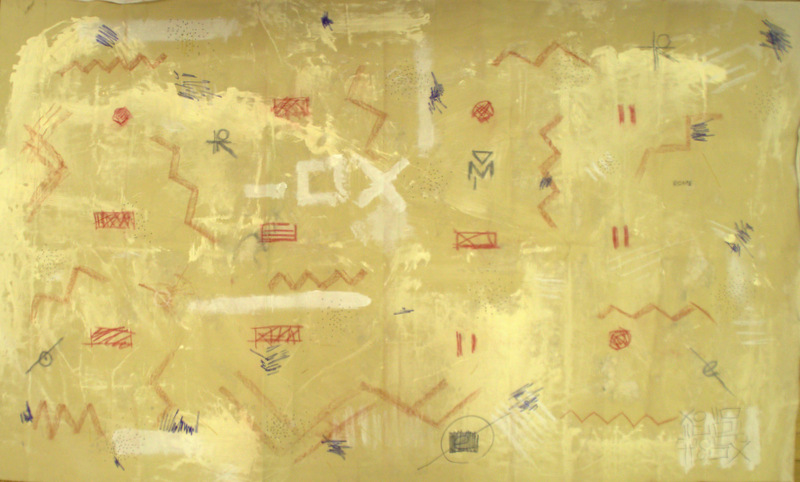
“ROME“, (ITALY), Mixed-media on unstretched canvas, before cutting into smaller pieces, 2013
Notes on placing “ROME“:
“I arrived in Rome by train. About a week earlier, I’d flown into Milan, and did a stay there for the European Alliance of Innovation (EAI) ArtsIT conference. I presented a poster there, and headed southbound to Rome. (More to add here later)“
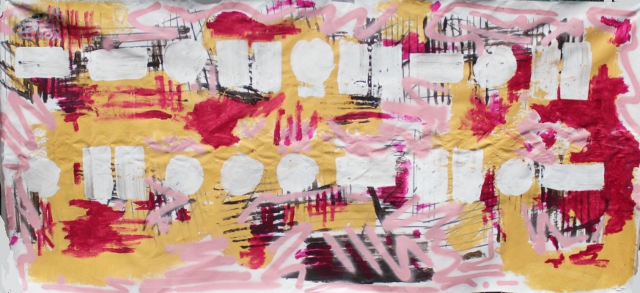
“GENEVA” (SWITZERLAND), Mixed-media on unstretched canvas, before cutting into smaller pieces, 2012
Notes on placing “GENEVA“:
“The GENEVA painting was one of the most exhilarating placements of all. I returned to Lyon from Berlin, more broke than when I’d arrived in Berlin. I asked the SNCF (train) information person if there were any trains to Geneva, that would be followed by a return train, back to Lyon in the same day. She said, “Yes. One goes there. But, the return train comes back 30 minutes after.” I decided to chance it, betting on locating a form of bookstore, library, or magazine shop to throw paintings into for discovery. I took the train imagining that it would be empty. But, it was filled to the brim, with the rush hour card. I was vacationing, but everyone else wasn’t. On the painting, I had pre-etched the pattern of where to cut the large painting to yield small pieces of exactly the same sizes. I pulled out my scissors, and calmly began to cut. But, due to the crowd, it became a feverish performance, as I cut the pieces against the clock to the surprise of adults and a few inquisitive kids, saying the most damned-ess truth and questions about what I was doing. Just very direct like, “What are you doing?” What’s morse code?” “Is that Art?”, “Why are you cutting it?” The adults tried to look composed, while in contrast the children spared no moment to ask each thought that came to mind. I explained, as I awkwardly, yet successfully cut each and every piece from the painting, while unable to unravel it for better vantage. I asked the father of the four or so children if I could gift them with a few pieces that I had cut. He said, “Yes, but hand them to me”. I handed them to him and he looked more giddy than the children. I saw an elderly French woman that had been looking stoic-faced and with a look of discernment the whole time. I said, ” Would you like a piece?”, and to my surprise, she exploded out of her shell with surprise enthusiasm, and yelled, “Of course, I want a piece! Of course I want one!”, as if she’d thought I would never ask, and was relieved at the opportunity. I passed out a few more pieces and escaped the train, thinking, I should have given them all to the entire train. I found a bookstore selling new books, immediately near the train station. I placed the paintings, then hurried back to the train station to return to Lyon. I didn’t receive a single response to those paintings I’d placed in the bookstore. But, that elderly woman, the father and those children on the train were enough. Such gratitude. It was beautiful.”

“BERLIN” (GERMANY), Mixed-media on unstretched canvas, , before cutting into smaller pieces 90.5 x 43.3 in (230 x 110 cm), 2012
Notes on placing “BERLIN“:
“I arrived in Berlin by flight, early in the morning. I’d flown in from Lyon, starving and broke, relying on a stay that I’d arranged in advance at Die Fabrik, a hostel in Kreuzberg. I rejoiced at the realization that the food in Berlin was about a third of the cost compared to what I’d found in Lyon—and delicious! The hotel staff were cool, and allowed me to hurriedly paint the painting that would become Geneva, in the light rain in the back of the building. I visited an art show for one of Berlin’s biggest collectors of action figure toys, and would meet a few people that offered a chat over beers. They’d point me in the direction of the “American Library” for placement of the “BERLIN” painting pieces. I tried to give a few pieces to the hotel staff. One denied the offer, as he stated” I don’t understand what you are doing, and don’t want to disrespect it.” Perhaps he deserved the piece for that sentiment, above all. Almost, similar the pieces were not retrieved from the library at first. People would visit the url address listed on the back of each painting piece. But, few-to-none would take the pieces for themselves. This social respect, for each piece to be experienced by the next discoverer in the same as the last, was a rare experience. This was explained to me by one of the people that directed me to the library where I placed the pieces.”

“PARIS“, FRANCE (Uncut), Mixed-media on unstretched canvas, 80 x 37 in (204 x 94 cm), 2012
Location: Biblioteque de Ecole des Beaux Art, Paris
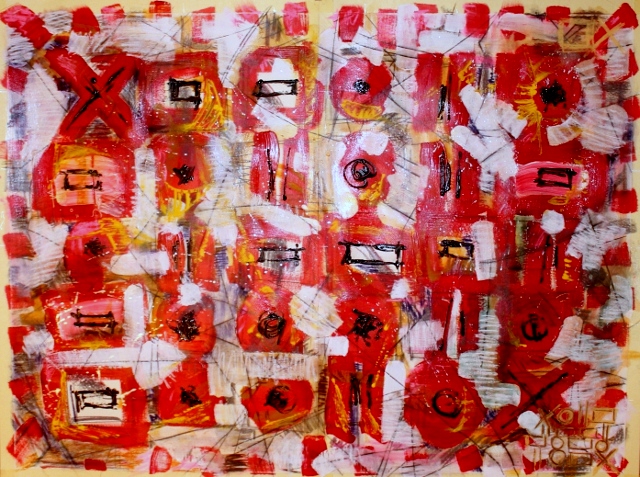
“GRENOBLE“, FRANCE (Uncut), Mixed-media on unstretched canvas, 2011
Location: Biblioteque de Ecole des Beaux Art, Paris

“MARSEILLE“, FRANCE (Uncut), Mixed-media on unstretched canvas, 2011

“VALENCIA“, SPAIN (Uncut), Mixed-media on unstretched canvas, 2011
Location: Biblioteque de Ecole des Beaux Art, Paris
Notes on placing “VALENCIA“:
“I drove into Valencia from Lyon by car, I had made the painting in Los Angeles. The painting was dry. However, it was thick and textured. I probably destroyed every book I placed the paintings in. But, some were discovered. The scene of the largest city library was odd… like a dungeon. I descended into it, as I recall it. There was a lower level that one must step into, and the mystique was of punishment. I couldn’t help but feel that each pair of eyes mine met held a sentiment like the child restlessly sitting in a chair that their mother or father sentenced them to for the duration of grown-up business that they’d tend to elsewhere in the department store. Everyone seemed to look to want to be rescued or had resigned to the thought of being condemned to sit there. If there were shackles binding them to the table, I would not have been surprised by their expressions. I didn’t want to place the paintings there, and thought “would they ever be found”. I left and ran into a woman at a bookstore, where I considered placing paintings. She suggested that I visit the library in the nearby University. I did and it was an incredible difference. The library was empty, while the lawn just outside of it was covered with students playing and talking. They seemed to have escaped, in a way that the others at the City library had only wished to. I placed the pieces in an empty library, without drawing suspicion, and I gradually received responses!“

“LYON“, FRANCE (Uncut), Mixed-media on unstretched canvas, 70 x 64.5 in (177 x 164 cm), 2011
I want to say something here, which I have found to be true of the experience of placing these small paintings which were discovered inside of books. The project of Placements is one of rapid assimilation into a society, not unlike what I had witnessed of my father that left, as he would say it “known for unknown” in 1966, by which a gift-like gesture yields the small contribution of attention from someone that discovers it to be of value… And what is this attention, if not love, to the ears of an initiate upon entering a room as they hear “Hello”? It is not odd that many of the young artists that do public-facing non-commissioned art are of immigrant parents, or newly transplanted to the terrain that they explore, as they place their works from one surface to the next.
When we finally, if we ever, make it beyond the conceptual model of a foreigner at the gate, and proceed to examine instead, the stranger that is within the self, trying to exchange value with what is outside in good faith, then perhaps the focal point will shift to the common interests that draws both parties to the same pages within a book, where curiosity and freedom give way to a space that is surprisingly comfortable—comfortable enough to fall into a deep sleep, to idly walk about at ease, to bear children and to know the children of your ideas, to take up swimming after a lifetime in the desert, to sing as if it did not matter the sound of your voice, to laugh without refrain and at sight of someone else, until you stop, reflect, look at each other, and laugh again.